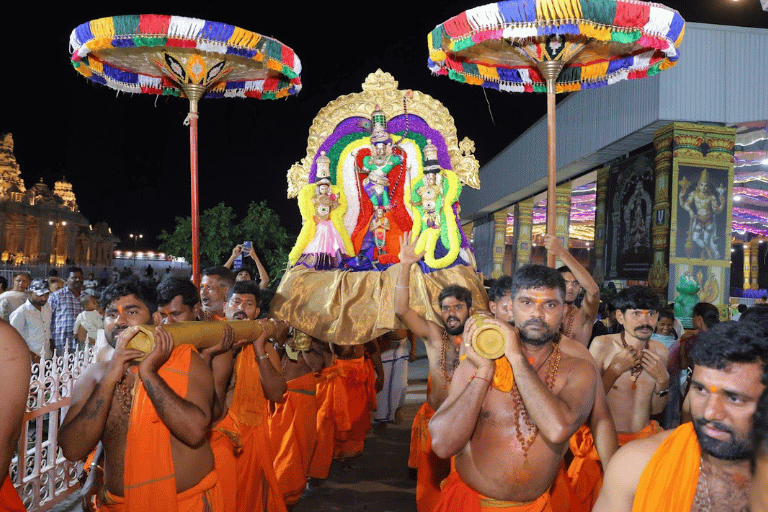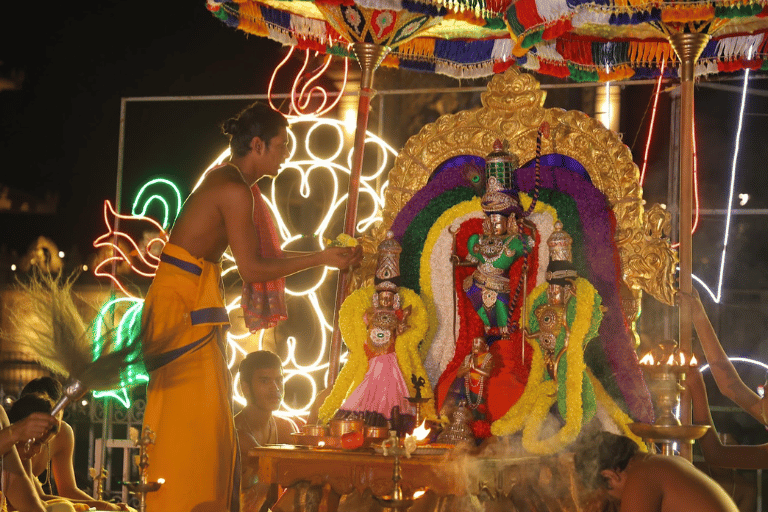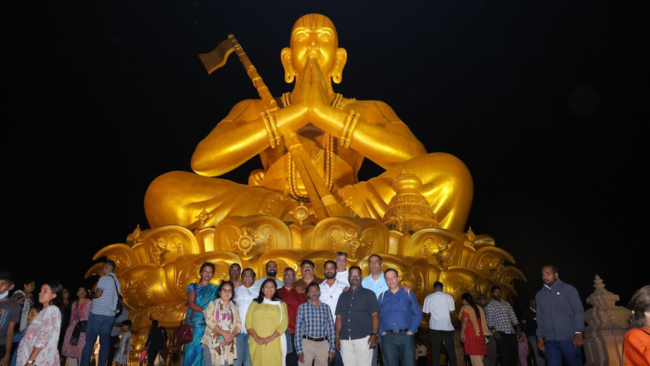
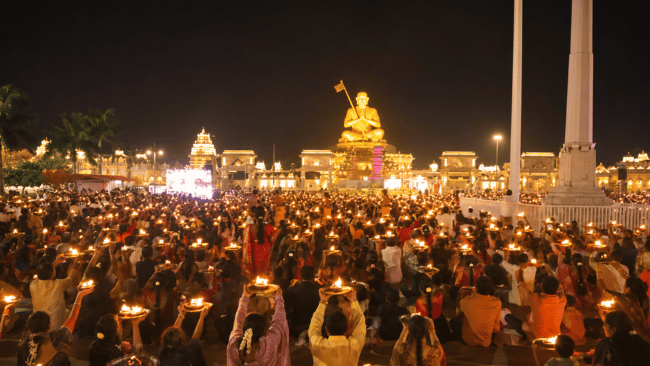
The auspicious Karthika Deepotsavam celebrations are held at the Statue of Equality on 24/11/2026. It focuses on participants’ and viewers’ understanding of the importance of Karthika Deepotsavam and how lighting a lamp equals yagna. The programme is planned and executed with the mangalasasanams and guidance of Sri Sri Sri Tridandi Chinna Jeeyar Swamiji in coordination with Shri Ahobila Jeeyar Swamiji, Shri Devanatha Jeeyar swamiji and esteemed scholar, Dr Samudrala Venkata Ranga Ramanujacharya Swamiji.
The initial programme in the festive ground is Bharatha Natyam for a Carnatic song, ‘naadhru dheemdheem (tillaanaa)’, to enhance the divine atmosphere. The second dance is for the Thallapaka Annamacharya song – ‘Kulukaka naduvaro kommalara, Jala jala raleeni jaajulu maa ammaku’. Later, Sriman Raghudatta swami, Pradhanacharya of Divya Saketam initiated the programme.
HH Devanatha Jeeyar Swamiji graced the dais and explained the importance of the name Damodara and the legend that associates Lord Vamana and Lord Krishna. When Bala Krishna steals butter, Yashoda wants to tie him to the mortar with a rope, but the rope isn’t enough, so she went on adding multiple ropes. Finally, the Lord himself allowed his mother to tie it, which caused a mark on his stomach. Consequently, he got a mark on his stomach, so he was called Damodara. He added information on how the months are named after stars by a combination of nakshatra and the moon during Poornima. This month, on Poornima Day, the Krithika nakshatra combines with the moon, so it is Krithika Deepotsavam.
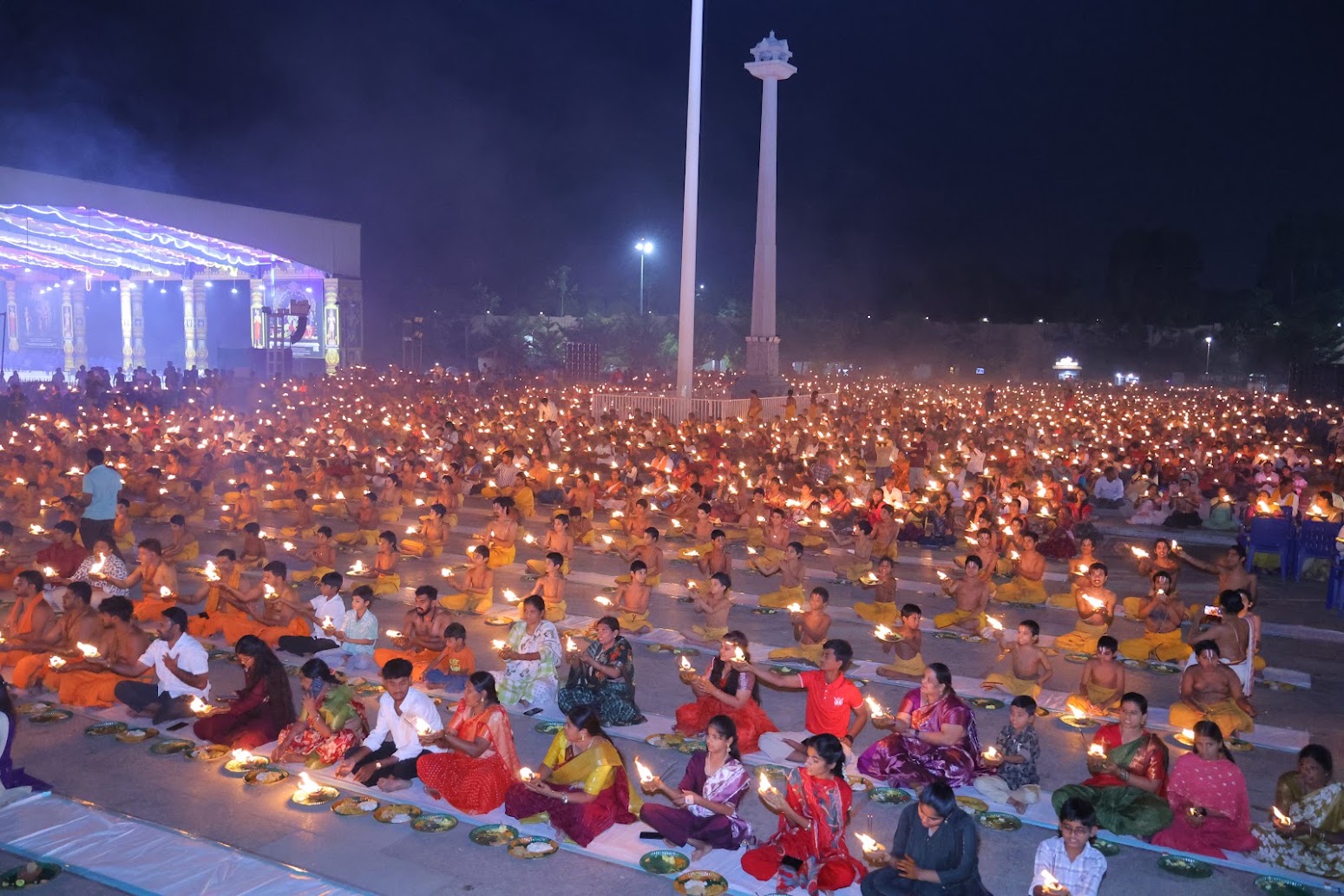
This Bali Chakravarthy lore illustrates the spiritual significance of lighting lamps on Karthika Poornima. Bali Chakravarthi, a powerful noble king and great-grandson of Hiranyakashipu, expanded his kingdom across the worlds. Knowing the fact that spiritual merit is equal to a yagna with Karthika Deeparadhana, he started performing it by taking a boon from Lord Vishnu to perform it without interruption. At that time, the Lord Indra requested Lord Vishnu to save them from Bali Chakravarthy. Thus, Lord Vishnu, in Vamana form (a small Brahmin), requested Bali for 3 paces of land; then he kept the first step on Earth and the second step in the Heavens and pressed Bali’s head into the Netherworld (Pathalaloka). Swamiji exclaimed that whoever performs deeparadhana on Karthika Pornima day in temples or inspirational centres like Divya Saketam will get the result of yagna (the sacrifice). Today, in Rama Sannidhi, with HH Chinna Jeeyar Swamiji’s mangalasasanams, devotees performed deeparadhana to get yagna results, and prayed to Him for an optimal state with the grace of Sri Ramanujacharya’s blessings.
The Deeparadhana programme was started by Shri Ahobila Swamiji by giving mangalasasanams to those who performed nruthya kainkaryam. He said it’s an auspicious day as the Perumal comes out of Yoga Nidra on this day. He is in yoga sleep from Ashada Pournami to Kartika Pournami. Diya is nothing but Laxmi Devi; Perumal likes her ever-smiling face. So on this special day, light a Deepam to show Laxmi Devi when he awakes. This is the reason people light multiple wicks as yagna on Karthika Poornima Day. Lighting 365 wicks symbolises the entirety of the year. ‘Yagna’ means ‘sacrifice’; hence, one needs to forget about it after performing. While doing Karma, if someone has a sacrificial nature, it is more than Bali’s Yagna.
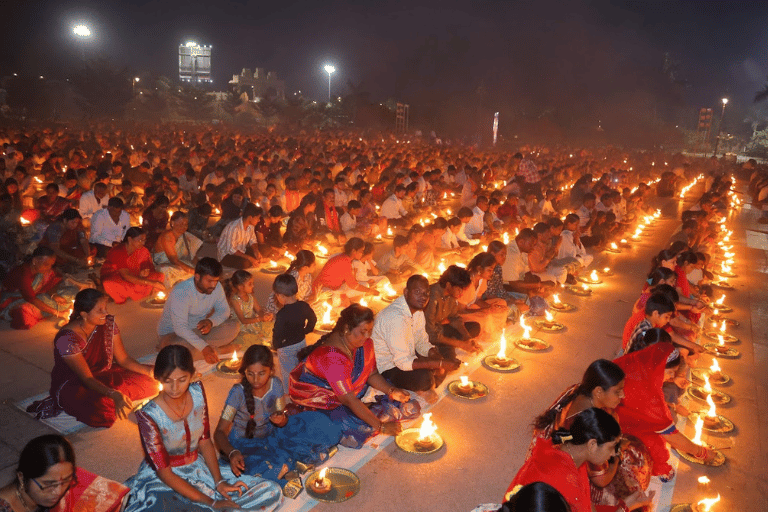
Pradhanacharya Sreeman Raghu Datta Swamiji , Shri Phani ji, along with dedicated volunteers, motivated nearly 5-6 thousand villagers and invited them to attend Deepotsavam. A large number of devotees participated in the rituals and offered prayers with great devotion to Lord Narayana. They lit the oil lamps and worshipped them with flowers, turmeric, and vermillion, viewing the lamps as the manifestation of Maha Laxmi Devi. He emphasised doing seva in temples with a broomstick, as it removes sins. As illustrated in the Aagama texts, a sand particle being cleaned at the temple, clears the sins of a thousand lifetimes. Like Srivari Seva in Tirupati (which is introduced by HH Chinna Jeeyar Swamiji), this seva is considered Acharya Seva in 108 Divyadesams. Statue of Equality invites dedicated devotees for seva to give their names to the Sreeman Raghudatta swami, Pradhanacharya or concerned Sarpanches. Devotees are instructed to keep sankalpam in Sri Rama Chandra Swami’s presence and collect poorna phalam (enchanted coconut) to tie it at home for the removal of evil and collect prasadam too. Also, ask them to light a diya, a dhoop stick, and do flower archana; recite Hanuman Chalisa to Hanumanji.
The next speaker, Dr Samudrala Ranga Ramanujacharyulu, an esteemed scholar at Jeeyar Research Unit, gave mangalasasanams to the devotees. Divine texts attribute special privileges during the Karthika month to the fire, Agni. Learned scholars say that Agni is for PROTECTION. The Agni they got at Upanayanam would be used to perform their final rites. In connection with that, he quoted a novel, Quest for Fire and encouraged the devotees to read good books. In the prehistoric period, people used to eat raw food, which was slowly roasted over a fire. So, since the invention of fire, primitive men started saving the fire. Likewise, Upanayanam is for everyone, but the processes are different from varna to varna. For that, he gave some examples like towel instead of yagnopaveetham, munjee bandhan, waist kati bandhan, etc. He quoted a line from a sloka of the Brihadaranyaka Upanishad…
Asathoma Sadgamay,
Thamasoma Jyothirgamaya
Mrithyorma Amruthangamaya
Om Santhi Santhi Santhi:||
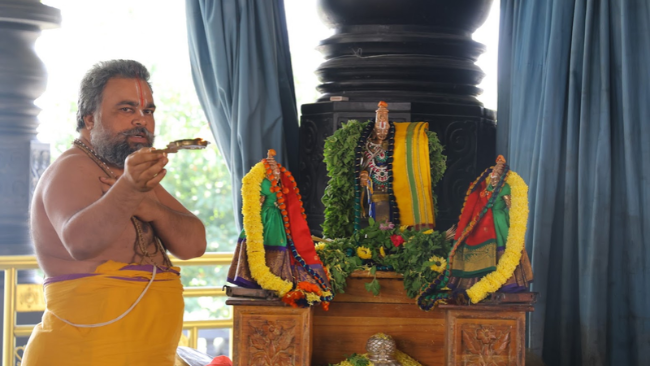
Thamasoma Jyothirgamaya means burning lamps lead the way from dark ignorance to lighting knowledge. It’s like waking up the inner consciousness. Our Alwars led and guided us to a jyothirmaya life. Accordingly, we need to keep a moorthy of Vishnu, Krishna, or Rama of one’s choice in gold, silver, copper, or stone and look at him intently while praying. Consequently, one should get the Perumal countenance in the aura of Deepam.
One can recite Sreemannarayana charanam saranam prapathdhye, Srimathe narayanaya namaha, at any time. It is good to light lamps at the temple on Karthika Poornima, so the devotees gathered in the premises of the 108 Divya Desam temples. Later, the Sreeman Raghudatta Swami led the pooja process step by step. He explained some traditional practices like Achamanam to adopt in their day-to-day lives. All the devotees performed puja under the moonlight, in front of the pleasant sight of Sri Ramanujacharya. They praised God for human life and asked him to lead their life in a better way. The puja was selfless with the right intention, signifying sacrifice because they prayed for the safety and betterment of humanity.
He referred to ‘Dharmodhikathamo mathaha’ from the purva peetika of the Vishnu Sahasra Nama Stotram. To protect dharma means that righteous duty, virtue, and the spiritual path are considered the highest of all. Sreeman Raghudatta Swamiji Pradhanacharyulu of Divya Saketam asked the devotees to learn the Vishnu Sahasra Nama Stotram to know how to follow the Dharma path. To show its importance, Sri Vishnu Sahasra Nama Stotram Jayanti is celebrated every year in the Magha month on Sudda Ekadashi. Therefore, let our children learn our divine texts, the Sri Vishnu Sahasra Nama Stotram, to follow the best path. The classes are free for all at Divya Saketam on every Saturday and Sunday.
During Yagnam, the fire or torch is Sri Samudrala Venkata Ranga Ramanujacharya Swami. By lighting the southeast grand torch pillar with 9 diyas while chanting divine prayers, Shri Abhobila Swamiji, Shri Devanatha Swamiji and Sri Samudrala Venkata Ranga Ramanujacharya Swamiji honoured religious dignitaries and staff who assisted them. It represents the poornahuthi process of yagna and helps the devotees to attain spiritual upliftment. Pradhanacharya Sreeman Raghudatta Swamiji announced Garuda puja for the eligible couple to have prasad for bearing children. The auspicious programme came to an end with divine chantings.