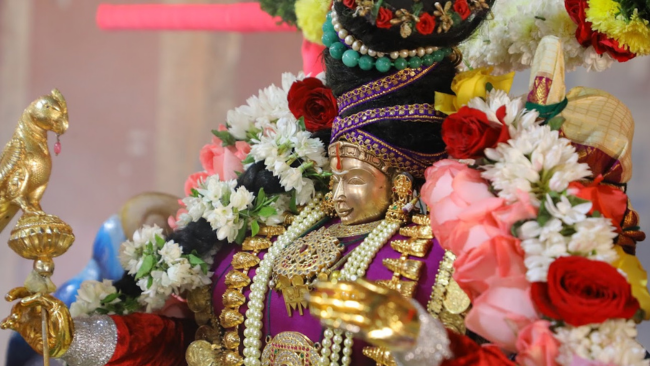
Dhanurmasam, a solar month, begins in mid-December and ends in mid-January. Dhanurmasam is called Margazhi in the Tamil calendar and Margashiram in the Telugu calendar. This month holds profound spiritual significance for devotees, helping them connect with Perumal and grow spiritually on their personal level.
Devotees recite Thiruppavai or Nalayira Divya Prabandham from the first day of Margazhi. During Dhanurmasam in Thirumala, acharyas read Thiruppavai instead of morning suprabhatam. Devotees either visit temples that open before dawn or offer prayers at home during the Brahma Muhurtham in Margazhi. Devotees believe visiting Divyadesams is a sacred task during Margazhi. For this reason, many devotees plan to visit Divyadesams in this month. Young girls observe Margazhi vratham, worshipping Lord Krishna for an upstanding companion and good fortune. Paramannam, Chakkera Pongali, Ven Pongal, Vangibath, Kadambam, and Thirumalai Champa are some popular neivedyams during Margazhi.
The important devotional book read during Dhanurmasam is Thiruppavai. It comprises 30 stanzas written by the poet Andal. She was the one and only female Alvar among the 12 Alvars. A childless Vishnu devotee, Perialvar found a baby under a tulsi plant in Sirivilliputtoor. She was given the name Andal. Her Thiruppavai stanzas praise Lord Vishnu and seek selfless service to him. She observed Margazhi, woke up in the morning, and visited the temple with friends to worship Lord Vishnu. Margazhi is important in Shaivism too; devotees read Thiruvempavai (20 stanzas).
In the early mornings of this month, oxygen levels are high, which helps the lungs and overall health. This is the reason morning rituals arose. Rice-flour rangoli with pumpkin flowers: the rangoli designs are not the regular type; they have intricate grids, patterns, and loops. Putting pumpkin flowers in the rangoli indicates a marriageable alliance at home. People firmly believe that those born in Margazhi are fortunate, devotional, and blessed with good luck and longevity. Moreover, the children born in Margazhi resemble their father, follow their father’s career, and respect family values. Further, the mornings are for devotion and meditation. Devotees gather in the morning in the streets to lead a procession with Bhajans. The Bhajan members sing Venkateshwara Suprabhatam, Jayadeva Ashtapadi, keerthanas, namavalis, etc. The host or temple serves sweet pongal and ven pongal neivedyams to the Bhajan participants early in the morning. Ginger, jaggery, sesame, and pepper are used extensively in neivedyam preparations to develop immunity and generate heat in the body. Usually, the participants carry their instruments to play while singing and sing a Mangalam song at the end.
The most important days during Margazhi are Thiruvathirai, Hanuman Jayanthi, and Vaikunta Ekadasi. In the Vaishnava calendar, Margazhi is meant for Lord Vishnu. On Thursdays, devotees fast and perform Laxmi puja for wealth and prosperity. The ekadasi during Krishna Paksha is Vaikunta Ekadasi. Devotees fast on this day; it equals 23 ekadashis in a year. Vaikunta Dvaram (the celestial gate) opens on Hanuman Jayanthi, which is on the new moon day with the Moola nakshatra. After the prayers, betel leaves and vada are offered to God Hanuman. During the Krishna paksham, on Vaikunta Ekadasi tithi, people visit Bhuloka Vairakuntam in great numbers in Srirangam to pass through the ‘swargavasal’ as it blesses the passerby with heaven after death.
In the parabhava year, during Margazhi month, the jyeshta nakshatram falls on 5th January 2027. It is a memorable day because of the esteemed Alvars and other Acharyas’ ‘Thirunakshathrams’. The last day of Margazhi is Bhogi, the first day of the Sankranthi festival. On Bhogi, a bonfire is lit to burn the old, symbolising a new beginning. The next day is Sankranthi (Thai Pongal); the farmers use the new harvest to cook rice payasam in new clay pots. Gobbemmalu, Gopuja, Chariot Rangoli, and Haridasa Keerthanas are the highlights at dawn. Sankranthi is followed by the Mattu Pongal in Tamil Nadu and the Kanumu in Telugu states.
Margazhi in Srirangam
Margazhi observance and celebrations are the most sacred in Srirangam. Taking Vaikunta Ekadasi as the focal point, the Adhyayana programme is divided into three divisions. The first division comprises ten days before Vaikunta Ekadasi and is called Pagal Pathu. Before Pagal Pathu, the acharyas chant Thirunedunthandagam. During Margazhi, daily rituals include Araiyar Seva by priest descendants. They do Araiyar Seva by chanting, using cymbals, and making hand gestures. During this Pagal Pathu, the procession idol of Namperumal leaves the sanctum every morning and reaches Arjuna Mandapam in a palanquin. Consequently, the Acharyas recite 1000 verses (Ayirams) from the first section of Nalayira Divya Prabandham. This treatise contains 4108 verses in four sections, composed by Alvars. On the last day of Pagal Pathu, Namperumal appears in Mohini form (the feminine form of Vishnu). The second division of the Adhyayana programme starts on Paramapada Vasal Thirappu, Vaikunta Ekadasi. The celestial gate, or gate to heaven, is open for devotees to pass through. Lord Ranganatha, in gem-studded attire, passes through the portal and reaches Thirumamani Mandapam during Ra Pathu. The third division comprises 10 more days, i.e., from the beginning day of Vaikunta Ekadasi. This period is called Ra Pathu, and the celebrations are in the afternoon and at night. During Ra Pathu, acharyas recite the remaining 3000 verses from Nalayira Divya Prabandham. The celestial gate remains open during Ra Pathu celebrations.
Margazhi Season
Margazhi is a season for classical arts, dance, and music in Tamil Nadu. A music academy was established in Chennai in 1927. To commemorate the academy, a music festival is organised every year. This year, the music festival runs from the 15th December 2026 to 1st January 2027 in Chennai. This is a remarkable 100-year celebration of the music academy. Top-notch Carnatic singers and violinists, mridangam vidwans, nadaswaram maestro, and sitarists participate in this music season. They are well-honoured and felicitated. Charur Arts Foundation also organises a music festival during Margazhi. This year, the Margazhi season will run programmes from December 15th to 31st. Fine arts and dance programmes are everywhere throughout Tamil Nadu. Other festivals include Margazhi Mahotsav, the Ananda Margazhi season, Krishna Gana Sabha Margazhi Mela, the OMR Margazhi festival, etc. During these Margazhi days, many temporary food courts arise to serve South Indian food to pilgrims on banana leaves.
Cross-cultural inspiration
Akira Lo, a Japanese photographer, visited Margazhi music programmes in Chennai in 2001 and was deeply moved by Carnatic music. Inspired by this, he started a project, ‘Margazhi Japan’, featuring classical musicians across Japan. This year, Margazhi Japan runs in October and November. In the USA, the iCarnatic conducted “Margazhi in USA” with many events in Detroit. VEDA Temple organised Margazhi Utsavam in Seattle; the Shrishti Foundation hosted classical dance and music performances in Orlando City, etc.
All these observances of Margazhi are called Pavai Nombu or Margazhi Vratham. Weddings and house-warming occasions are not celebrated in this month, as it is allocated to spirituality. Chilly mornings, sacred street bhajans, oil lamps, and Thiruppavai recitation during Margazhi mornings spread spiritual ambience and strengthen unswerving devotion. Kachi sarees, filter coffee, and steaming sweet pongal add an aesthetic appeal to Margazhi.