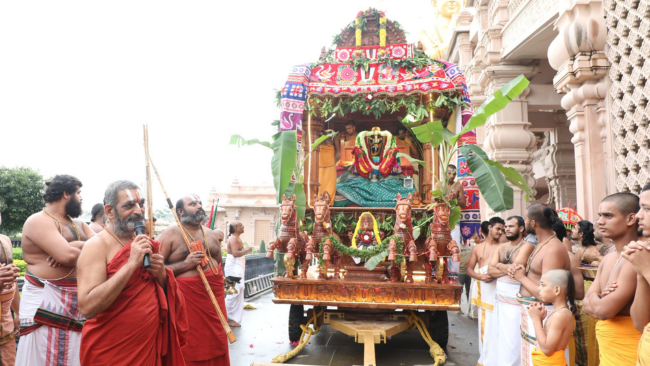
Jagannath means Lord of the Universe! He, along with his elder brother Balabhadra and sister Subhadra is receiving worship from the countless devotees at his abode atop Nilanchal hill on the Puri coast. From time immemorial, a sea of humanity throng the three kilometer stretch from Jagannath temple (Shreemandir) to Gundicha Mandir on the Jagannath Rath Yatra day. Every practice at Jagannath Dham is unique to itself, in the sense it is different from other temples.
The ceremonial process of Jagannath Rath Yatra begins with Devasnana Purnima, or Snana Yatra, the ceremonial bathing festival of Lord Jagannath, Balabhadra, and Subhadra. It takes place on the full moon day of the Hindu month of Jyeshtha. The legend from the Skanda Purana states that King Indradyumna arranged this bath when the deities were first installed.
The deities are brought out to the Snana Bedi (bathing altar) and bathed in 108 pitchers of water infused with sandalwood paste, saffron, and camphor. After the bath Lord Jagannath gives Darsan in Ganesha attire.
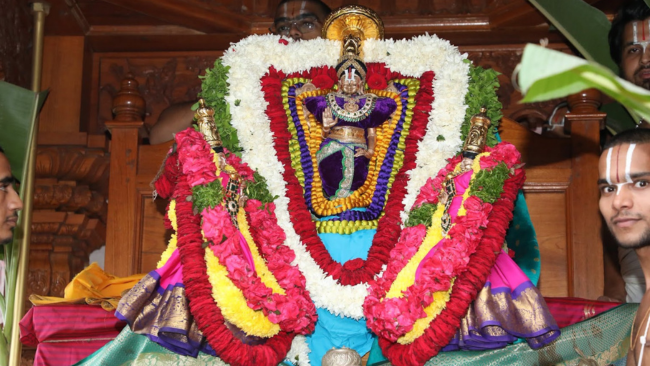
The Lord gets fever!
After the bath, the deities are believed to “catch a fever” afterward. They retreat into an isolated “sick room” (Anasara Ghara) for 15 days, where they are treated with herbal medicines and only represented by painted cloths (Anasara pattis) until the famous Rath Yatra.
Chariots are constructed every year!
Each year the Raths are constructed a new. The process of locating the suitable wood logs starts immediately after the Rath Yatra and about 800 logs of selected saced species of trees are collected. The construction of grand chariots, styled as moving temples, starts on Akshaya Tritiya day. 220 hereditary artisan including carpenters, blacksmiths, sculptors, tailors and labourers are involved in the construction that takes 57 to 60 days to complete. The towering chariots are put together using strictly traditional joinery, wooden pegs, and basic hand tools. While blacksmiths forge iron rings or clamps for reinforcement, no modern nails are used.
On the Rath Yatra day, the deities are brought to the respective chariots in a systematic process. While Lord Sudarshana and Devi Subhadra are carried forward flat on the shoulders of the priests, Lord Jagannath and Lord Balabhadra are kept upright, systematically paused, and swayed back and forth in a dance-like motion. As the deities reach the northern exit of the dancing hall (Natamandapa), they are adorned with giant, delicate, semi-circular crowns called Tahias. Handcrafted from Sholapith, these massive floral headpieces sway dynamically with every movement of the lords. The ritual occurs amidst a chaotic, ecstatic wall of sound generated by traditional bell-metal gongs (Ghantas), cymbals, conch shells, and traditional trumpets.
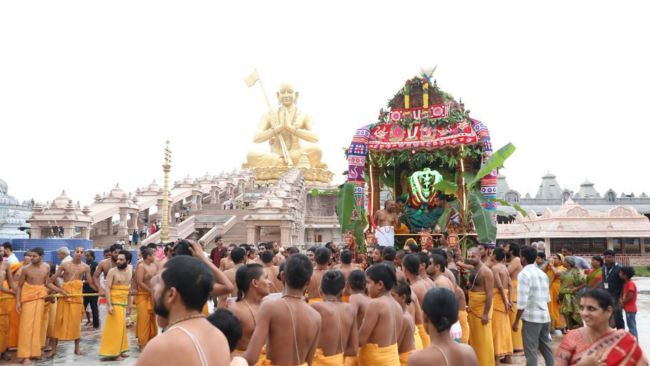
Rath Yatra is the Lord’s Compassion!
Spiritually, the Rath Yatra represents the ultimate act of divine compassion. Because non-Hindus and foreigners are traditionally not allowed inside the main temple, Lord Jagannath voluntarily steps down from His isolated throne. He comes out into the open avenue (Bada Danda) so that any person, regardless of caste, creed, or nationality, can see Him, touch Him, and pull His chariot.
The King becomes the servant of the Lord
Once the deities are seated in chariots, the most celebrated ritual of the Rath Yatra, epitomizing the ultimate expression of humility and equality before the divine takes place. In this ritual, the Gajapati Maharaja (the King of Puri)—traditionally considered the first servitor of Lord Jagannath—acts as a humble sweeper, cleansing the floors of the three grand chariots with a golden broom.
The Lord has an aunt!
Thereafter, lakhs of devotees pull the chariot for three kilometers, to reach the Gundicha temple. Gundicha was the wife of the legendary King Indradyumna, but is treated as maternal aunt for the deities. In this temple, the deities spend nine days of vacation, before returning to Shrimandir. Interesting development takes place on the fifth day of their vacation! On that day, Goddess Lakshmi (Lord Jagannath’s wife), furious at being left behind at the main temple, travels to Gundicha Temple in a palanquin. Out of anger, her servitors damage a piece of wood on Lord Jagannath’s chariot (Nandighosa) before she stealthily returns via a side street.
The Return Journey (Bahuda Yatra): On the ninth day, the deities board their refurbished chariots once more to head back to the main shrine. On the way back, they stop at the Mausi Maa Temple to eat Poda Pitha, a baked rice cake made with jaggery, coconut, and lentils.
After completing their nine-day stay and returning to the main temple gates, the deities are taken off their chariots. They enter the temple using the Goti Pahandi style—a slow, careful procession where one deity is safely placed inside before the next one begins moving.
Lord is locked out of his abode!
While Lord Balabhadra, Subhadra, and Sudarshana enter the temple without any trouble, Lord Jagannath finds His path blocked at the Jaya Vijaya Gate by His wife, Goddess Lakshmi. Goddess Lakshmi is deeply hurt and angry because Lord Jagannath left her behind in the main temple while he went on a nine-day vacation to the Gundicha Temple with his siblings. On her orders, the temple servitors shut the main gates right in Lord Jagannath’s face, locking Him out of His own home.
A fascinating, humorous verbal duel takes place between the servitors representing Lord Jagannath (Daitapatis) and those representing Goddess Lakshmi (Devadasis or Maharis). The King’s representative acts as a mediator. Lord Jagannath offers various excuses for His absence, while Lakshmi accuses Him of neglecting her.
Lord pacifies Goddess Lakshmi
To pacify His angry wife and gain entry, Lord Jagannath resorts to a sweet peace offering. He presents her with delicious, soft Rasgullas.
Pleased by the sweet gesture and the Lord’s humble apologies, Goddess Lakshmi relents, forgives Him, and opens the heavy gates. Lord Jagannath then finally enters the inner sanctum to rejoin His siblings on the golden throne.