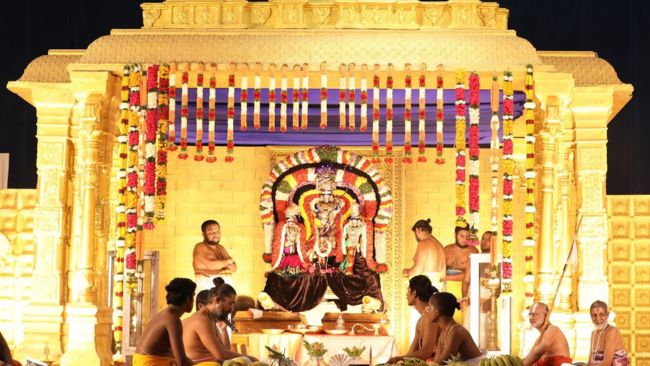
May 21, 2026, marked the sacred day of Punarvasu Nakshatra, an asterism associated with Lord Rama. At Divya Saketa Kshetram, the asram established by HH Chinna Jeeyar Swamiji in Muchinthal, a unique spiritual tradition has been observed continuously since the consecration of the temple of Lord Kodanda Rama in 2009. Between two consecutive Punarvasu days, once every 27 days, the entire Valmiki Ramayana is recited by a dedicated swami. At the completion of each cycle, the divine Kalyanam and Pattabhishekam (Coronation) of Lord Rama are ceremonially performed.
Sacred Punarvasu Day and the 216th Ramayana Milestone
The Punarvasu day of May 21, 2026, was especially significant, as it marked the completion of 216 full recitations of the Valmiki Ramayana. To commemorate this extraordinary milestone, Sri Chinna Jeeyar Swamiji had invited devotees to participate in the sacred Sri Sita Kalyanam and Maha Samrajya Pattabhishekam celebrations. Thousands of devotees gathered at the Pravachana Mandapam to take part in the divine proceedings.
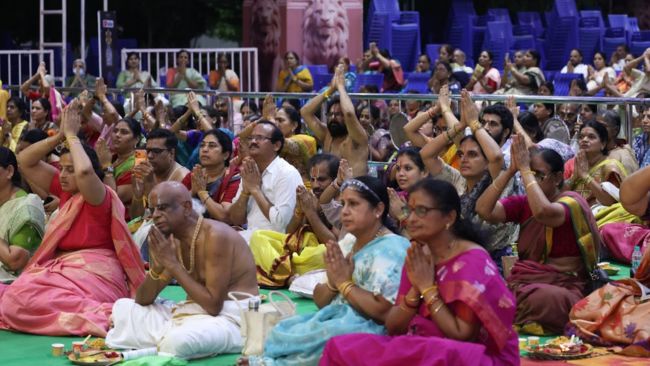
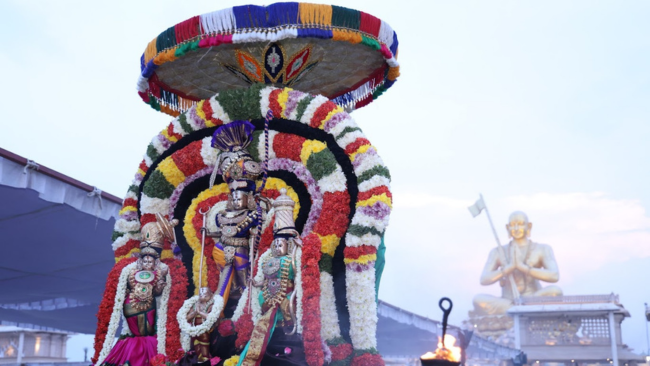
The coronation dais was adorned with magnificent royal splendour worthy of the Emperor of Ayodhya and the Lord of the Universe. Resplendent golden hues dominated the decor, lending the entire setting an aura of majesty and divine grandeur. Lord Rama and Sita Mata were seated upon the royal throne, while Lakshmana and Hanuman occupied elevated pedestals alongside.
Sri Sita Rama Kalyanam Celebrations
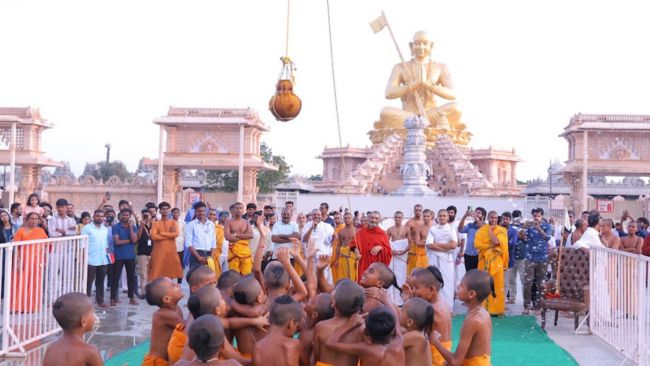
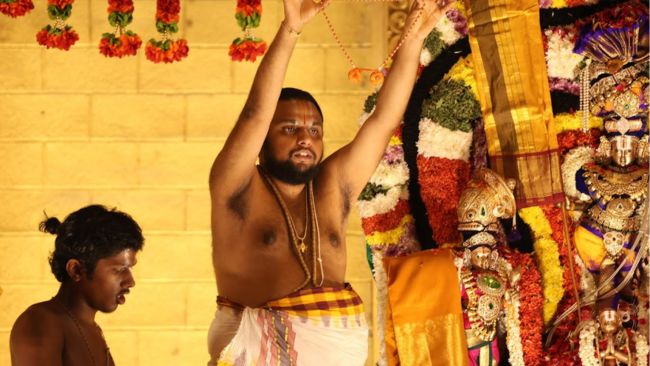
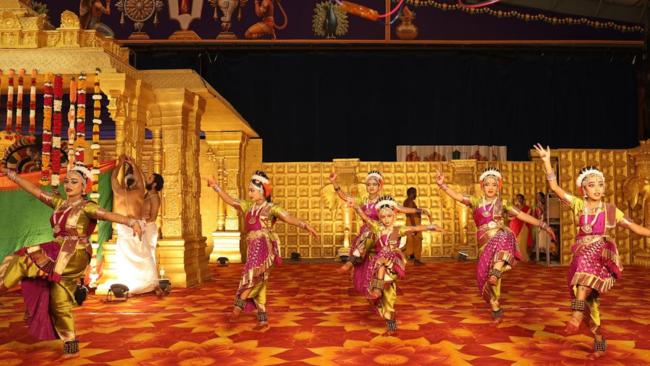
The celebrations began with the celestial wedding ceremony of Sita Mata and Lord Rama. One of the most cherished moments for devotees was the traditional garland exchange. Four young priests carrying garlands performed graceful rhythmic movements to the melodious strains of the popular “Maalai Saatrinaal” song ”, delighting the assembled devotees.
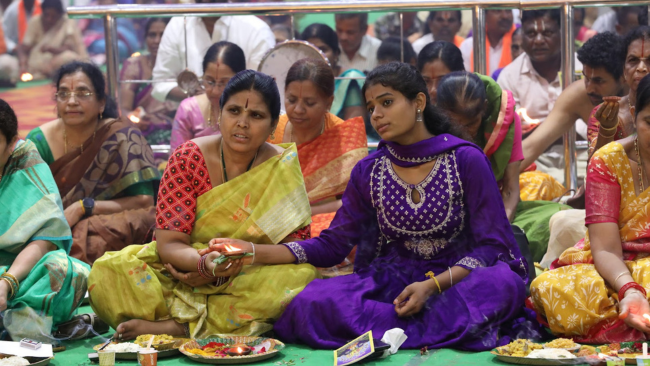
Following the Kalyanam, each devotee received a prayer plate containing oil, a lamp, water, incense sticks, kumkum, flower petals, turmeric powder, and other sacred items required for worship. HH Chinna Jeeyar Swamiji personally moved among the devotees, distributing the holy Padukas (sandals) of Lord Rama.
Swamiji then guided the devotees through a deeply devotional meditation. He requested them to imagine themselves journeying to Chitrakoot, where Lord Rama, Sita, and Lakshmana once lived in a humble leaf-covered hut, just as Bharata had done to request Rama’s return to Ayodhya. Devotees were instructed to light lamps and incense, offer turmeric and flowers to the Padukas, and invoke Lord Rama to symbolically wear them.
Rama Paduka Worship and Swamiji’s Spiritual Message
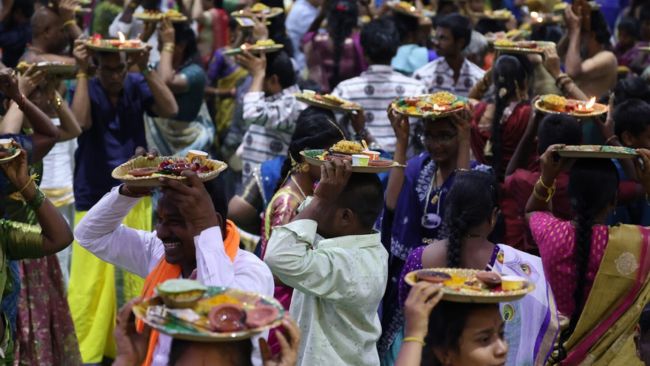
The devotees then performed traditional upacharams, offering water for washing the Lord’s feet, towel, drinking water, food, and betel nut, in a manner that honoured guests were traditionally welcomed in Indian households. Thereafter, they were guided to invite Lord Rama to reside within their hearts. Finally, each devotee lifted the plate carrying the Padukas onto their head and circumambulated the hall, imagining they were taking the sacred Padukas home.
At this point, Sri Swamiji shared a profound spiritual message. He recalled how Bharata had placed Lord Rama’s Padukas upon the throne at Nandigram and ruled Ayodhya on their behalf. During that period, the kingdom prospered immensely, and the treasury multiplied tenfold. Bharata treated the Padukas not as mere sandals, but as the living embodiment of Lord Rama Himself. Each item of revenue and gift was first offered before thePadukas, and all expenditures were undertaken only after seeking their symbolic permission.
Swamiji then asked the devotees how many experienced stress in managing household responsibilities, businesses, jobs, and personal challenges. Nearly everyone raised their hands. He encouraged them to emulate Bharata’s devotion by considering Sri Rama’sPadukas as the true owners of their homes and themselves merely as caretakers acting on behalf of the Lord.
He advised devotees to share both their successes and difficulties with the Padukas. By surrendering responsibilities in this manner, he explained, stress would naturally diminish. Swamiji illustrated this with a simple analogy: a pen held by a student during an examination feels no stress; only the student experiences it. Similarly, one should see oneself merely as an instrument in the hands of the Lord. Through such surrender, both spiritual and material prosperity would flourish manifold.
Grand Pattabhishekam of Lord Rama
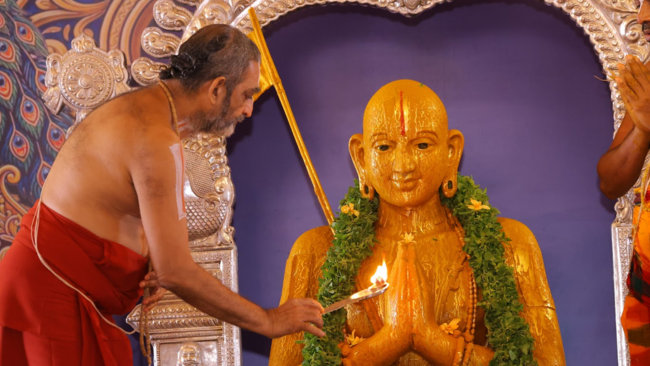
The grand Pattabhishekam (coronation ceremony) then commenced. Sri Swamiji first honored the priest who had completed the monumental feat of reciting the Valmiki Ramayana 216 times. Lord Rama was adorned with a new crown, royal umbrella, and other ceremonial paraphernalia befitting a newly crowned emperor.
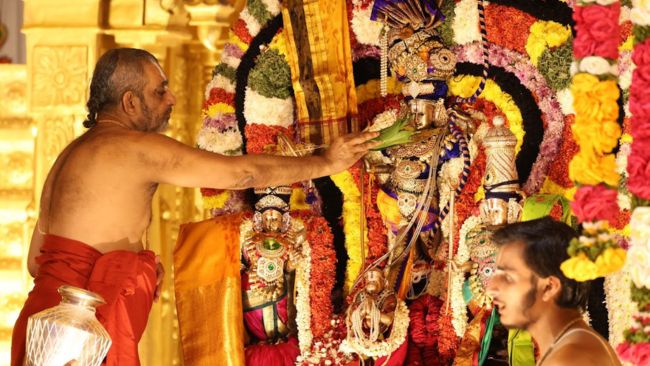
Amid the chanting of sacred Vedic hymns, a holy abhishekam was performed using waters collected from 40 sacred sources, including Himalayan rivers, seas, holy rivers, and sacred teerthams from pilgrimage centres such as Tirumala. The sanctified water was later sprinkled upon the devotees as a blessing of purification and divine grace.
On this auspicious occasion, Sri Swamiji also announced a new eleven-day prayer observance beginning on May 30, the birth anniversary of the revered saint Nammalwar. During this vrata, devotees are encouraged to bathe early and begin reciting the Sudarshana Mantra by 6:00 a.m., chanting it 1008 times daily.
Swamiji led the devotees in reciting the mantra:
“Om Sri Sudarshanaya, Hatirajaya Namaha!”
HH Swamiji explained that this eleven-day spiritual practice is intended to protect devotees from both anticipated and unforeseen challenges arising from wars, natural calamities, and climatic disturbances and so on, while also strengthening their spiritual resilience and inner peace.
Devotees across the world are warmly invited to participate in the sacred Sri Sudarshana Mahamantra Homam through live online streaming or by attending in person.
Join this divine spiritual gathering and receive the blessings of the sacred yajna while becoming part of a collective prayer for peace, protection, and universal welfare.
By
Venudhar Reddy Nukala